I want one of these...
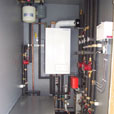
The plan all along has been to install radiant floor heating. It’s still the plan, but yesterday we got an eye opener when I called the local installer who quoted over 15 G’s for the boiler room and $14 / square foot for running the tubing. Ouch! In my calculation, the raw materials for the entire installation should be about 1/4 his quoted price.
From what I can tell, the guy I called is one of the best in the business. His website says he’s friends with Richard Trethaway on This Old House. Like Richard, he’s a Viessmann dealer/rep, and Viessmann boilers and equipment are notoriously pricey. Sure, it would be nice to own the Mercedes of boilers, but do we really need one?
I think I’ll start calling around for alternative bids…
4 Comments
Ann·April 12, 2005
Ouch! That does sound high.
What have you learned about radiant heating? Does it need to be run off a separate system or can a regular boiler be hooked into it. One plumber told us that in spite of our radiant heating throughout the house that we couldn’t use it for radiant heating in the kitchen since the pressure was too great.
Ann·April 12, 2005
We have radiators not radient heating throughout the house — just to clarify.
Derek·April 12, 2005
I was thinking radiant would be cool, not at that price though. It seems like the main floor would be easy, since the basement is unfinished. And I could tear out the slab in the basement. I think we’re stuck with forced air though, maybe a couple electric radiant zones, in the bathroom, and the kitchen nook. I’ve read about open and closed systems, I think for the whole house you need a closed system. We have radiant heat at my work, it’s surprising how small the boiler is for 4000sq. ft.
Nick·April 12, 2005
Ann -
You should be able to use a single boiler to provide potable hot water for drinking, and for different types of heating - including both radiators and radiant-floors. The trick is designing a system that incorporates the necessary mixing valves to achieve different temperatures and pressures on the different circuits. And, any potable water circuit needs to be entirely separate from heating circuits (the water cannot mix), and this is done by using heat exchangers - devices that transfer heat from one flow of water to another without having the water actually touch.
Derek - our plan is to gut the 1st floor, including the finish floor and the ceiling. This will allow us to laydown an “over floor” system on the first floor, and use an “under floor” system in for the second floor (installed in the joist cavities). For your basement, you could lay down an “over floor” system — no need to tear up the slab, as long as it’s flat…